Showing posts with label Soviet Union. Show all posts

Tuesday, May 1, 2012

May Day, Moscow 1927


You still have about two more weeks to see the show, Diego Rivera: Murals for The Museum of Modern Art (at MoMA) before it closes on May 14. The exhibit assembles material from the exhibit of Rivera murals some 80 years ago. In 1931, MoMA brought Rivera to New York, where he, with the help of two assistants, created the murals on site, at the museum, a mere six weeks before the exhibit opened. Five murals were ready for the opening and three more were created during the run of the show.

In addition to the mural panels, preparatory sketches and supporting archival material on view, there are 45 pages from a Rivera sketchbook. In 1927, The Soviet government invited the Mexican muralist for the May Day celebrations on the tenth anniversary of the Russian Revolution. The watercolor and crayon sketches document the crowds the pageantry, and an ordinary family preparing for the festivities of the day. The connection of the May Day sketches to the MoMA murals, however, was not aesthetic, but financial. It was Abby Aldrich Rockefeller’s purchase of the sketchbook that helped fund Rivera’s trip to New York for the 1931 show.

Kevin Kinsella of the blog New First Unexpected points out that the sketchbook had another mural connection, though not one related to MoMA. Apparently, Rivera was to create a mural in the reception room of the Red Army’s High Command. The May Day sketchbook, though impressive as visual reportage, was intended rather, as preparatory work for the commission. 

MoMA has all the sketchbook pages online.


Friday, January 27, 2012

Soviet Chess Books

Above, the Botvinnik-Tal match, 1960

Is there another game with as much in the way of illustrative, graphic and metaphoric possibilities? You’ve got royalty, war, strategy, various figures and characters, not to mention the black and white checkered board on which the game is played.

The importance of chess in the Soviet Union cannot be overstated. As Grandmaster Anatoly Karpov, World Chess Champion, 1975-1985 put it, “Chess in Russia is like baseball in America.”

Paul Hoffman interviewed Karpov (above) in 2010. Here’s an excerpt.

Question: Why has Russia dominated the chess world?

Anatoly Karpov: Because of long time traditions and chess was... chess was part of intellectual life in Russian Empire. And so big writers, great writers they were playing chess and so this was privilege in part of top society, in top society people. And then after the revolution, new power, they saw in chess the tool of bringing knowledge and education because it was easy, it was cheap and if you recall the time when revolution happened, most of educated people and top society people they left the country. And so new power should work out something to make new intelligencia and new intellectual people. And so they believed that with the help of chess they could do it, and especially it’s very cheap compared to any other things. I don’t talk even about sport, but about other subjects and sciences. And that’s why it was supported and even during civil war, when we had civil war in 1920, first championship for Soviet Russia took place. And later it became part of education system, before World War II. And after all chess became national game. Like you have here in America, you have baseball, and so Russia had chess.


The Chess ABC-Book, Czech book published in Russian, 1983.

"Kids Play Chess"
Kindergarten textbook, 1991


Garry Kasparov's game with Deep Blue

Grand master Eduard Gryunfeld, left, and "I Prefer to Risk" about five time world champion, Nona Gaprindashvili. She was the
first woman grandmaster.


1927 book about famous game between Alehin and Capablanca.


Third world champion J. R. Capablanca.


"The Praxis of My System," by A. Nimzovich, 1962

"Become a Grand Master," 1985


Chess magazines, 1966.


Chess game journal.


Books are from eBay and antiquarian bookseller sites.

Wednesday, February 16, 2011

Soviet Book Jackets

Krasnoznam, Balt Flot (Red Banner Baltic Fleet).

There are 656 “Russian bookjackets, 1917-1942” digitized on the site the New York Public Library. So though it may look like I got carried away, it was really with great difficulty that I limited myself to the selection here.

While going through these, I was struck by how the cover designers did not confine themselves to the vertical rectangle we see when a book is closed in front of us. Instead, the entire horizontal expanse of the fully unfolded jacket was utilized as designable space. I’m not sure why this was, but perhaps it had to do with the absence of the capitalist mentality that considers every available square inch of printable surface as an opportunity to “sell.”

The entire collection is presented in a “wide screen” format, as opposed to the American and European dust jackets, which are displayed with a squarer aspect ratio of cover-plus-flap or a vertical format of the front cover alone. That is a collection of over 2,000. Something to look forward to …
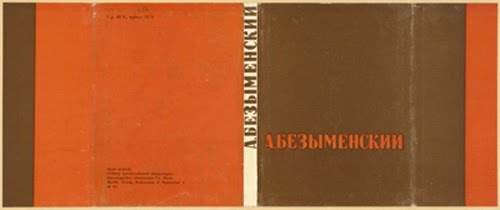
Bezymenskii, Stikhi (Poems), 1934.


Sel'vinskii, Pushtorg (Fur-Trade), 1931.


Kuznetsov, Tsirk (Circus), 1931.


Chukovskii, Skazki (Fairy-Tales), 1935.


Sovetskoe iskusstvo za 15 let (Soviet Art over 15 Years), 1933.


Boitsy pervogo prizyva (Soldiers of the First Call).


Skazki Severnogo kraia (Fairy-Tales of the Northern Region), 1934.


Sobolev, Kapital'nyi remont (Major Repairs), 1933.


Dos Passos, Tri soldata (Three Soldiers), 1934.


Voenlety, Rasskazy o voenno-vozdushnom flote (Military Pilots, Stories about Air Force.), 1933.


Blagoi, Tri veka (Three Centuries), 1933.


Boitsy pervogo prizyva (Soldiers of the First Call).


Sto let Aleksandrinskomu teatru (A Hundred Years of the Aleksandrinskii Theater), 1932.


Lidin, Idut korabli (Ships are Sailing), 1928.


Gornaia promyshlennost' (Mining Industry), 1932.


Koster (A Campfire), 1934.


Chetyre pokoleniia, Kniga o Narvskoi Zastave (Four generations, A Book about the Narva Gate) 1933.


Slavin, Interventsiia (The Intervention), 1933.


Belyayev, Pryzhok v nichto (Jump Into Nowhere), 1932.


Lapin, Podvig (A Heroic Exploit), 1934.


Permitin, Kogti (Claws), 1932.


Chekhov, Vishnevyi sad (Cherry Orchard), 1933-35.


Shternberg, Giliaki (Giliaks), 1933.


Maiakovskii, Groznyi smekh (A Menacing Laugh) 1932.


Panferov, Bruski, t.2 (Bruski, Vol.2) 1933.


Bibineshvili, Kamiu (Kamiu), 1934.
Related Posts with Thumbnails