Thursday, April 21, 2011

Ads From a Simpler LIFE

"It’s only 31 miles from New York City and
is a very pleasant drive."
This gracious invitation from Con Edison to come and view the Indian Point nuclear facility, was one of two ads for nuke plants that ran in the June 16, 1967 issue of Life.

Westinghouse, who built the reactor for Connecticut Yankee, the plant at Haddam Neck, also advertised in that issue. CY was shut permanently in 1996 and has since been decommissioned.
"The plant will be a welcome neighbor—as clean and quiet
as any good neighbor could be."


"… made with Monsanto ingredients that just refuse
to go wrong—no matter who stirs them up."
A Monsanto ad in the same issue.


"We may be the only phone company in town, but we
try not to act like it."
This AT&T ad encouraged home shopping and reassured us as to just how benevolent a monopoly it was.


“Born loser” is a term we don’t hear much these days. Sure, we have high unemployment, but we’ve got high self-esteem to match. We’re all winners these days, as our kids’ shelves of meaningless trophies, prove. The only losers we tolerate now are weight losers.


One of four cigarette ads in the issue.


Remember Polaroid? This simple ad really looked great running inside the front cover.

Tuesday, April 19, 2011

The Illustrated Exodus


I’ve tracked down a version of the very traditional Haggadah I remember from my youth, first published by Shulsinger Brothers in 1950. The illustrations by Austrian-born artist Siegmund Forst, depict in realistic detail, scenes of the Jews’ exodus from Egypt and various other characters and stories from the Haggadah. When I was a kid, I would pore over these illustrations during the lengthy recitation of the text. I considered them very instructive and I was not bothered in the least by how sentimental they were. I was fascinated that they showed me how it really looked when Egyptian soldiers were swallowed by the Red Sea, and exactly what the Angel of Death looked like (a skeleton with wings and a scythe). It also served as a handy guide to stereotyping men by their appearance.


The Haggadah actually acknowledges that not all children are exactly the same. “The Four Sons” represent four types of children and outlines how to discuss the exodus from Egypt with each type.

Upper right, the wise son (looks a lot like Moses!); upper left, the wicked son; bottom right, the simple son: bottom left, the son who doesn’t even know how to ask a question.


Scenes of the Jews in Egypt: Above, building pyramids. Below, Pharaoh's daughter discovers Moses in his basket in the reeds.

This illustration goes with a “cumulative” type of folk song that’s been around for a few hundred years called Chad Gadya. It’s ostensibly a lively song for children about the fate of a boy’s goat, which his father bought for him. The song describes successive acts of violence that go all the way up the food chain from animals, to man, to the Angel of Death, to God.

Chad Gadya, however, is not merely a simple child’s song. There have been many interpretations of it. Here is what Elie Wiesel has to say about it.
And here we are, concluding the seder with Chad Gadya, a beautiful song, which is not just about a father who buys a goat for his child. It's a song about God's creatures destroying each other. It may be a puzzling way to end the joyous meal but one that is fraught with meaning.

The song of Chad Gadya reminds us that in Jewish history, all creatures, all animals, all events are connected. The goat and the cat, the fire and the water, the slaughterer and the redeemer, they are all part of the story.

And surely it has to be symbolic, for how can a cat eat a goat in the first place?

Thursday, April 14, 2011

The (Low) Power and The Glory

Media reform advocate, Pete Tridish (aka Petrie Dish), of Prometheus Radio Project, sartorially celebrates a hard won victory for community radio. The decade-long struggle for access to the low-power frequencies of the airwaves finally resolved with passage by Congress of the Local Community Radio Act, which was signed into law by President Obama early this year.

Ten years of curtailed access to the low-power FM spectrum had been based on claims by the powerful National Association of Broadcasters that LPFM broadcasting would interfere with their signal. A congressionally-ordered study later found those claims to be without merit. The repeal of these restrictions, opening the airwaves for hundreds of new community stations, will be felt especially in urban markets where the ban had its greatest impact.

Celebrating passage of the Local Community Radio Act was one of the inspirational high points of last weekend’s National Conference for Media Reform in Boston. This gathering of some 2,500 activists, journalists and scholars, organized by Free Press, covered a wide range of media reform issues.

As they say in LPFM circles, “Low Power to the People!”


Photos by Michael Scurato

Monday, April 11, 2011

The ABCs of Fairy Dust


Very few stores are better at sensory overload than ABC Carpet & Home. Even when you think you cannot absorb one more dazzling display, pattern, color or texture, ABC’s “Visual Team” successfully manages to impose yet another layer of retinal stimulation.

So it was at a recent event held at the store, that I found myself under the spell of what the ABC employees call “fairy dust.” It might appear as glittery graffiti on a mid-century étagère, or as carefully arranged dried buds peeking out from under a porcelain dinner plate. Even when the pixies take it up a notch for special events the effect remains subtle as the sparkles, petals and powders blend naturally with the flickering candles and the ambient surface reflections. After last week’s Apartment Therapy meetup, where Mira Nakashima-Yarnall, daughter of George Nakashima, talked about the work of Nakashima Studios, I had to take a closer look at these ethereal flourishes.


“Fairy dust” also graces the always otherworldly store windows.


Mira Nakashima-Yarnall, signing books, after her presentation.

Saturday, April 9, 2011

Sticker Shock


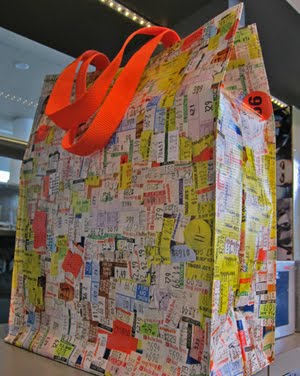
I’m in Boston this weekend, and yesterday I found myself right next door to the ICA with a few spare minutes. Not enough time to look at art, but just enough, to case the gift shop.

I immediately zeroed in on a bag, which I was pretty sure I wouldn’t be able to resist. It was printed with overlapping price stickers of all kinds. How well I know those encrustations of stickers, the ones that accumulate on assorted kitchen surfaces, or seem to grow on various notebook pages. And those big neon orange ones emblazoned with 99¢--I always have to save those. Well, restraining myself was not the least bit difficult (and it’s a good thing that I am not at a loss for bags) because the price of this “shopper” was $99.99! The sign next to the bag said “$hopping Bag” Created by ICA exhibited artist Rachel Perry Welty. Edition of 999. Signed and numbered by the artist."

I’m seeing a DIY project in my future …

Tuesday, April 5, 2011

It's Mr. Lucky's Day

It was just around now, early April, that I took a trip to Arizona, a few years back. I shot lots of great signs around Phoenix, but those will have to wait for another day. I’m afraid this post belongs to Mr. Lucky’s.

Monday, April 4, 2011

Original Crumb


On a recent Friday night, a certain corner of New York’s fashionable Upper East Side was overrun by a decidedly unfashionable crowd. Fans of underground cartoonist Robert Crumb, came out in full force, patiently waiting in a line that circled the block, for entry to R. Crumb: Lines Drawn on Paper. The retrospective show is now at the Society of Illustrators, through April 30th.


In an AP interview we learn that Crumb is mystified as to why anyone would want to see his creations in a gallery. “For me,” he says, “the printed copy is the magic moment.”

Consider this 90-piece exhibit covering four decades of inked output, a ‘magic moment’ for the rest of us—the opportunity to see original drawings from Crumb’s own hand, fetshized as art. Kind of like getting the rude, perverted, adolescent utterances straight from the maestro’s own filthy mouth. It’s something you don’t want to miss.


There are, actually, some fashionable Crumb fans.


Click image to see it bigger.


“God bless Crumb. I’ve always been happy that there was
someone as sick and twisted as I am.” —George Carlin


R. Crumb: Lines Drawn On Paper
A Retrospective of the work of R. Crumb


Tuesdays 10:00-8:00, Wednesdays – Fridays 10:00–5:00, and Saturdays noon–4:00.

The Museum of American Illustration at the Society of Illustrators
128 East 63rd Street
New York, NY 10065
212.838.2560

Ends April 30th


Crumb has a terrific website.
I highly recommend the timeline of his comics.

Related Posts with Thumbnails